
Roof Ventilation Upgrade in Brea, CA
In short: In short: this page covers roof ventilation upgrades in Brea, CA 92821 — balanced intake and exhaust sized to your attic volume, installed as part of a replacement or standalone. Poor ventilation voids warranties and cooks shingles from below. First step: a free attic inspection where we measure your current airflow.
Ventilation is the most undervalued part of a roof replacement. Without balanced intake and exhaust, heat and moisture get trapped in the attic — cooking shingles from below, growing mold, and voiding manufacturer warranties. Every roof replacement we do in Brea includes a ventilation assessment, and most include an upgrade to a properly balanced system.
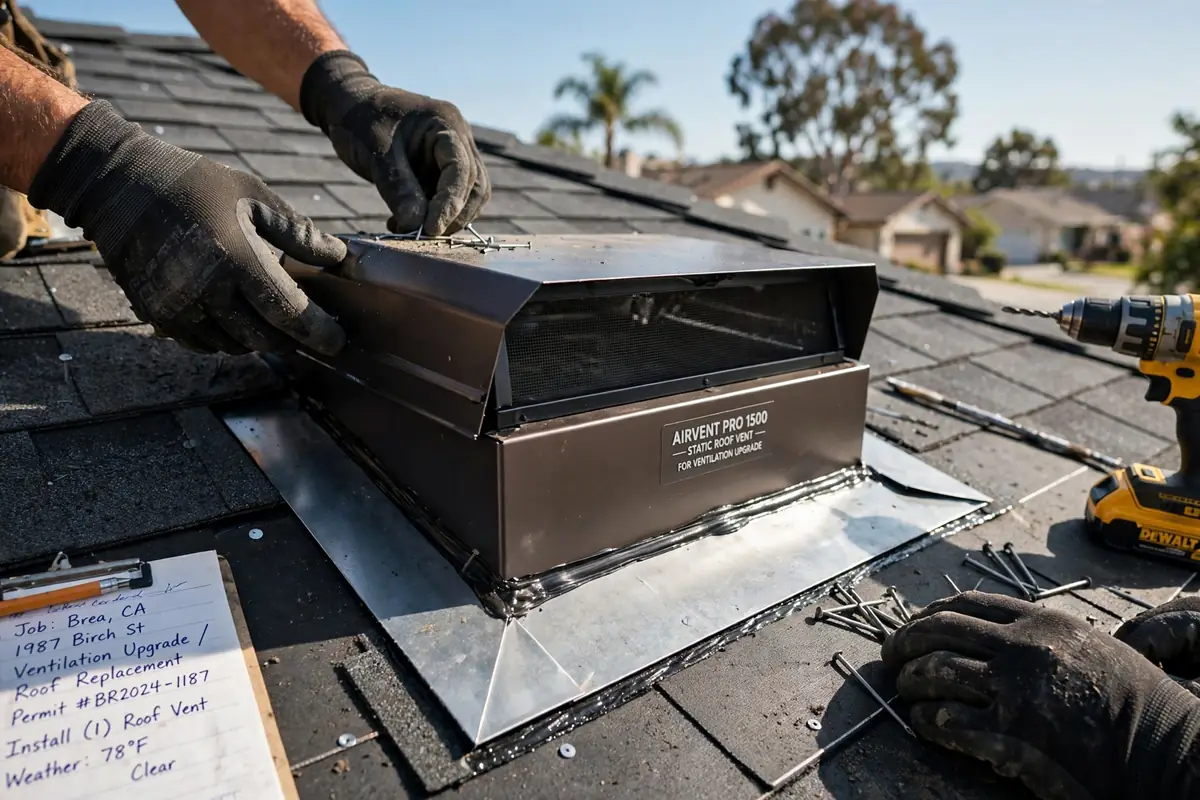
What This Service Includes
We calculate your attic's net free vent area against the 1:150 (or 1:300 with vapor barrier) standard, then design intake (soffit vents) and exhaust (ridge vent, and in some cases powered or solar vents) as a balanced system. The upgrade happens while the roof is open, when adding ridge vent or correcting blocked soffits is straightforward.
Signs You Need This Service
- Excessive attic heat in summer
- Mold or mildew on attic sheathing
- Frost on the underside of the deck in winter
- Curling shingles on a relatively young roof
- Ice dams despite adequate insulation
How We Do It Right
Ridge vent paired with clear soffit intake is the gold standard for most Brea homes — silent, passive, and effective. We also correct the common problems we find: painted-over soffit vents, blocked baffles, bathroom fans venting into the attic, and mixed exhaust types fighting each other. Proper ventilation can add years to a new roof's life and is required to keep most manufacturer warranties valid.
Roof Ventilation Upgrade for Brea Homes
hot, dry summers and Santa Ana wind events make attic ventilation critical in Brea: trapped heat cooks shingles from below and voids warranties. We design balanced ventilation into every replacement.
Related Roofing Services
Skylight Replacement During Reroof
Replace aging skylights during your Brea reroof — new units flashed directly into the new roofing system.
Asphalt Shingle Roof Replacement
Architectural shingle replacement for Brea homes: full tear-off, new underlayment, and premium shingles rated for heat and Santa Ana winds.
Tile Roof Replacement
Clay and concrete tile roof replacement in Brea, including underlayment renewal — the waterproofing layer that decides a tile roof's life.
Metal Roof Replacement
Standing-seam and exposed-fastener metal roof replacement in Brea — 40-70 year lifespan, fire resistance, and energy-saving reflectivity.
Areas We Serve
Brea Hills
Roof replacement in Brea Hills, Brea.
Tamarack
Roof replacement in Tamarack, Brea.
Olinda Ranch
Roof replacement in Olinda Ranch, Brea.
Downtown Brea
Roof replacement in Downtown Brea, Brea.
Helpful Guides
Energy-Efficient Roofing Options for Brea Homes
Guide from Roof Replacement Specialists.
7 Signs Your Brea Home Needs a Roof Replacement
Guide from Roof Replacement Specialists.
How balanced ventilation works
Cool air enters at the eaves through soffit vents, washes the underside of the deck, and exits at the ridge — carrying heat and moisture out continuously. The ratio matters: roughly 1 square foot of net free vent area per 150 square feet of attic floor, split evenly between intake and exhaust. Most Brea tract homes we inspect have plenty of one and none of the other — usually gable vents or a power fan with painted-shut soffits. We calculate your attic volume, specify the vent schedule in the written scope, and verify airflow paths are clear of insulation.
Ventilation components we install
Ridge vent along the peak (the workhorse — even, quiet, no moving parts), undereave soffit vents or vented drip edge where soffits are sealed, and baffles that keep insulation from choking the intake channel. We remove or disable power attic fans in most cases: they depressurize the attic and pull conditioned air from the house, raising bills while masking the real problem. Turbine vents get replaced with ridge vent wherever the ridge length allows — fewer penetrations, better distribution.
Ventilation upgrade costs
As part of a full replacement, bringing ventilation to standard typically adds a few hundred dollars — ridge vent, soffit vents, and baffles are inexpensive materials; the value is in the calculation and the installation. Standalone ventilation retrofits run higher because of the dedicated mobilization, but still far less than the premature roof failure they prevent. We price it as a separate line item so you see exactly what the airflow is worth.
Brea's ventilation epidemic
Brea's 1960s–80s tracts were built when ventilation was an afterthought: small gable vents, no soffit intake, and decades of repainted-shut vents since. Summer attic temperatures in these homes routinely hit 150°F, which cooks shingles from below (granule loss accelerates), bakes the underlayment, and forces AC systems to fight a radiant oven. Every replacement we do in Birch Hills, Country Hills, Tamarack, and West Brea includes a ventilation correction — it is the single highest-ROI line item in the whole job.
Signs your attic is suffocating
The tells: an attic that feels like a furnace on a warm afternoon, shingles curling years before their time, rusted nail heads in the attic (moisture condensing), and winter mildew on the deck's underside. In Brea's 1960s–80s homes we find painted-shut soffit vents so often it is nearly diagnostic — the intake was sealed decades ago and nobody noticed. The inspection measures intake and exhaust area directly; the numbers do not lie.
Frequently Asked Questions
How do I know if my attic ventilation is adequate?
Our inspection measures actual intake and exhaust vent area against your attic square footage. Most homes we inspect in Brea are under-ventilated, often significantly.
Is a ridge vent enough by itself?
Only if intake exists to feed it. A ridge vent with blocked or missing soffit vents can actually pull conditioned air from the house. Balance is everything — which is why we design the system, not just the vent.
How do I know my ventilation is bad?
Three tells: an attic that feels like a furnace on a warm afternoon, curling or prematurely aging shingles (heat damage from below looks like age from above), and moisture or mildew on the underside of the deck in winter. We measure it directly during inspection — intake area, exhaust area, and whether insulation blocks the path — and show you the numbers.
Will more vents void my shingle warranty?
Proper ventilation protects your warranty; improper ventilation voids it. Manufacturers specify minimum ventilation for warranty coverage, and we document our vent schedule with photos. The vents that cause trouble are the wrong kind — mixing power fans with ridge vent, or exhaust without intake — which is why the calculation comes before the installation.
Can ventilation be added without replacing the roof?
Yes, as a standalone retrofit: we cut in ridge vent, open or add soffit intake, and install baffles from inside the attic. It is more labor per vent than during a reroof (no open deck to work from), but it is absolutely doable and often the right first step when the roof itself still has years left.
Can I just add a power fan instead?
We usually recommend against it. Power fans depressurize the attic and pull conditioned air out of your living space through every ceiling penetration — raising cooling bills while masking the real problem, which is missing intake. Balanced passive ventilation (soffit in, ridge out) moves more air, silently, with no energy cost and nothing to break.