
Flat Roof Replacement (TPO & EPDM) in Brea, CA
In short: In short: this page covers flat and low-slope roof replacement in Brea, CA 92821 — TPO, EPDM, and modified bitumen systems with corrected drainage and heat-welded seams. Ponding water is the enemy; we design slope into every replacement. First step: a free inspection with a drainage assessment.
Flat and low-slope roofs fail differently than pitched roofs: they live or die by drainage and seams. Our flat roof replacements in Brea start with correcting the fundamentals — slope, drainage, and penetrations — then install a modern single-ply membrane (TPO or EPDM) as a fully adhered or mechanically attached system with heat-welded or taped seams.
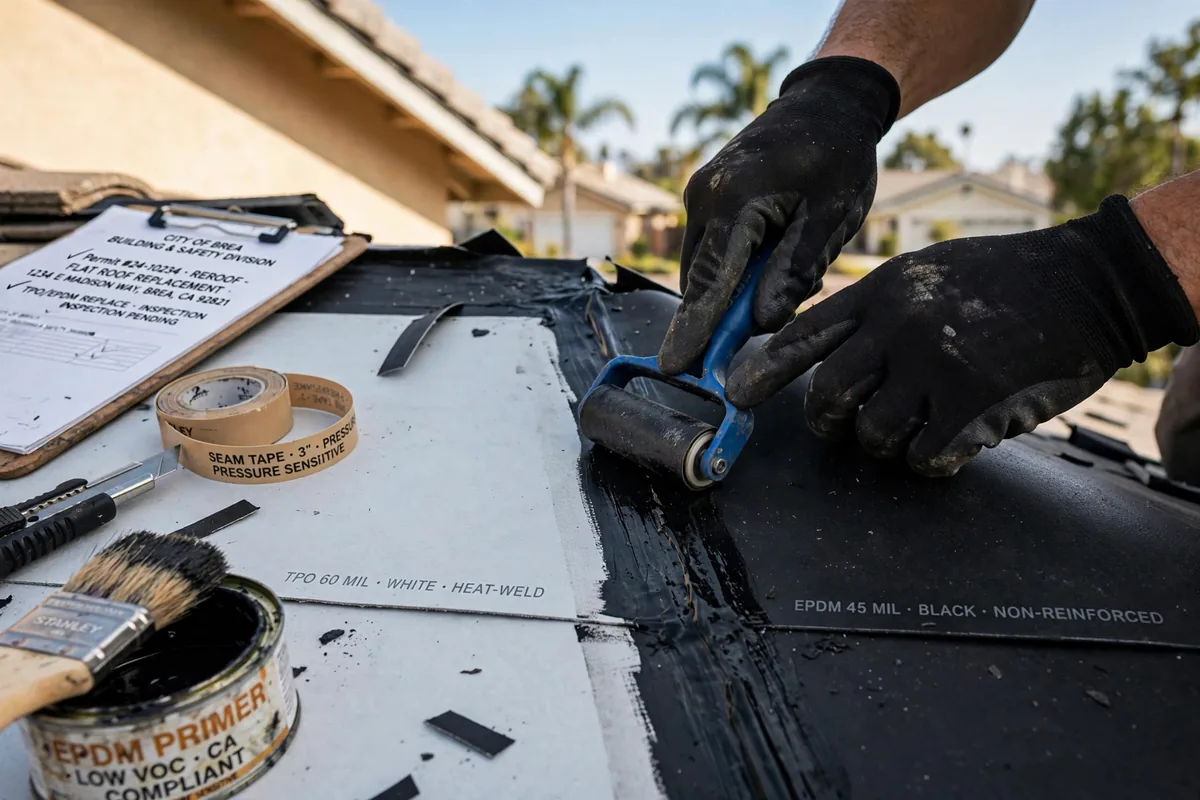
What This Service Includes
We tear off the failed membrane down to the deck or insulation, address any ponding areas with tapered insulation, replace damaged substrate, and install the new membrane with new flashing at every curb, vent, and parapet. The result is a monolithic waterproof surface with far fewer failure points than the built-up or modified-bitumen roofs it replaces.
Signs You Need This Service
- Ponding water that stands more than 48 hours after rain
- Blisters, bubbles, or separations in the membrane
- Seam failures or open laps
- Leaks around vents, skylights, or parapets
- An aging built-up (tar and gravel) roof past 20 years
How We Do It Right
We install 60-mil TPO (white, reflective, heat-welded seams) or 60-mil EPDM (black, extremely durable, ideal for certain exposures) depending on the building and budget. Every replacement includes tapered insulation design where drainage needs help, new metal edge details, and a thorough reseal of every penetration. Expect 20 to 30 years from a properly installed single-ply system.
Flat Roof Replacement (TPO & EPDM) for Brea Homes
Brea's hot, dry summers and Santa Ana wind events are brutal on flat roofs: ponding, UV breakdown, and seam stress. Our replacements correct drainage first, then install membranes engineered for this exposure.
Related Roofing Services
Roof Tear-Off & Redecking
Complete tear-off to the deck with damaged sheathing replaced — the foundation every long-lasting Brea roof needs.
Emergency Roof Replacement
Emergency dry-in and fast-tracked full replacement for Brea homes with active leaks or storm damage. Call line answered 24/7.
Partial Roof Replacement
Targeted replacement of damaged roof sections for Brea homes — matched materials, proper tie-ins, full warranty on our work.
Energy-Efficient Cool Roof Replacement
Cool-roof replacement in Brea: reflective shingles, metal, or membranes that cut attic heat and cooling costs.
Areas We Serve
Brea Hills
Roof replacement in Brea Hills, Brea.
Tamarack
Roof replacement in Tamarack, Brea.
Olinda Ranch
Roof replacement in Olinda Ranch, Brea.
Downtown Brea
Roof replacement in Downtown Brea, Brea.
Helpful Guides
How Much Does Roof Replacement Cost in Brea?
Guide from Roof Replacement Specialists.
Storm Damage Roof Replacement in Brea: A Homeowner's Guide
Guide from Roof Replacement Specialists.
TPO vs. EPDM vs. modified bitumen
TPO (thermoplastic polyolefin) is the default for most Brea flat replacements: white, reflective, heat-welded seams that become one continuous sheet, 20–30 year life. EPDM (rubber) suits complex roofs with many penetrations — its flexibility handles movement, and it goes down fast. Modified bitumen (torch or self-adhered) fits small residential flat sections and tie-ins to shingle roofs. We recommend by roof geometry and budget, not by what we have on the truck.
Drainage is the real job
Flat roofs do not fail because of the membrane; they fail because of standing water. Every replacement we do starts with a drainage plan: tapered insulation crickets that move water to drains and scuppers, properly sized outlets, and overflow protection. Brea's winter cloudbursts dump inches in hours — a flat roof that ponds for 48 hours after every storm is a roof being destroyed slowly. We photograph ponding areas during inspection and show you the cricket layout before we start.
Flat roof pricing
Flat replacement is priced per square foot of membrane plus the drainage correction scope — tapered insulation, new drains or scuppers, and edge metal. TPO and EPDM land in a similar range per square; modified bitumen can cost less on small areas but more in labor on complex ones. The line item homeowners underestimate is insulation: bringing an old flat roof up to current R-value during replacement is the cheapest energy upgrade in roofing, and doing it later costs triple.
Brea's flat-roof realities
Brea's flat roofs cluster on mid-century homes with additions, apartment buildings around Tamarack and West Brea, and commercial-style parapet sections on newer builds. Two local killers: UV that cooks black membranes (another reason we default to white TPO) and Santa Ana winds that peel poorly adhered edges. We mechanically fasten or fully adhere per wind-zone calculations and terminate every edge in metal — glued edges alone do not survive a Brea October.
Maintenance that doubles membrane life
Flat roofs reward simple maintenance: clear drains and scuppers twice a year (Brea's fall leaf drop and spring seed drop), keep foot traffic on walkway pads, and recoat or reseal penetrations when the inspection flags them. A 20-minute seasonal check catches the ponding and seam stress that become expensive. We include a maintenance checklist with every flat replacement — and the first annual inspection is on us.
Frequently Asked Questions
TPO or EPDM — which is better for my building?
TPO's white reflective surface cuts cooling costs and its heat-welded seams are exceptionally strong. EPDM has a longer track record and handles building movement well. We recommend based on your roof's specifics, not on what we happen to stock.
Can you fix ponding water during replacement?
Yes — this is one of the best reasons to do a full replacement. We design tapered insulation layouts that create positive drainage to scuppers or drains, eliminating the ponding that killed the old roof.
How long does a TPO roof last in Brea?
20 to 30 years. UV is the aging factor and white TPO handles it far better than black EPDM or old built-up roofs. The seams are the strength: heat-welded TPO seams are stronger than the sheet itself, so failures almost always trace to flashing or drainage, not the membrane.
Can you fix ponding without replacing the whole roof?
Sometimes. If the membrane is healthy, tapered insulation crickets and added drains can solve ponding under a recover. But if the membrane is aged, blistered, or has multiple patches, replacement with designed drainage costs less over ten years than nursing a failing roof.
Is a white roof too bright for my neighbors?
On flat roofs it is rarely visible from the street — that is the nature of parapet construction. Where a low-slope section is visible, we can use gray TPO or a walkway pad pattern that reads as intentional. Glare complaints are essentially nonexistent on residential flat work.
Can you install a flat roof in winter?
Yes, with weather windows. TPO welding and adhesives have temperature minimums, so we schedule around Brea's mild winter days and never weld in rain. Winter's shorter days mean tighter scheduling, but the work quality is identical — the membrane does not know what month it is.