
Roof Tear-Off & Redecking in Brea, CA
In short: In short: this page covers roof tear-off and redecking in Brea, CA 92821 — stripping every old layer to the wood deck, replacing rotted or delaminated sheathing, and installing a new code-compliant deck before the new roof goes on. It is the foundation every long-lasting roof needs. First step: a free inspection that includes an attic deck assessment.
Every roof replacement we do in Brea starts with a full tear-off, because the deck beneath the shingles is the foundation of the entire system. When tear-off reveals rotted, delaminated, or under-built sheathing, redecking — replacing the damaged wood with new code-compliant sheathing — is what separates a roof that lasts 30 years from one that fails in 12.
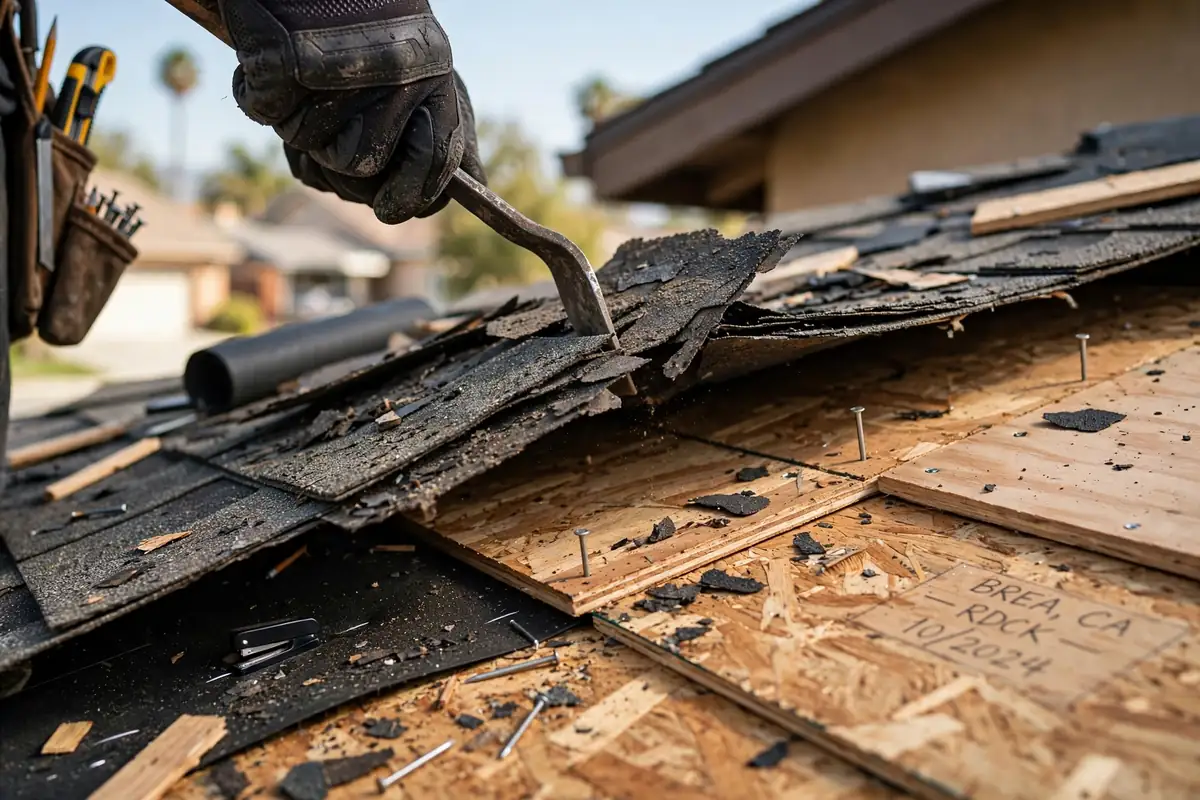
What This Service Includes
We strip all existing roofing layers, fasteners, and underlayment down to the bare deck. Every sheet of sheathing is inspected: soft spots, delamination, water staining, and inadequate nailing are marked. Damaged sections are cut out and replaced with new OSB or plywood of the correct thickness, properly gapped and nailed to current code, before a single square of new roofing goes on.
Signs You Need This Service
- A spongy or bouncy feeling when walking the roof
- Visible sagging between rafters
- Water stains on the underside of the deck in the attic
- Multiple existing roofing layers adding hidden weight
- Homes built before modern sheathing standards (common in Brea's older neighborhoods)
How We Do It Right
Redecking is priced per sheet so you only pay for what is actually replaced — and we photograph every replaced section for your records. In Brea we frequently find original 1950s-70s sheathing that has served well but is too thin or too damaged for another 30-year roof. Replacing it now, while the roof is open, costs a fraction of what a premature re-roof would cost later.
Roof Tear-Off & Redecking for Brea Homes
In Brea, where a mix of older bungalows near downtown, 1970s-80s tract homes, and newer hillside developments like Blackstone and La Floresta, we routinely uncover original sheathing that has earned retirement. Redecking during replacement is the foundation a 30-year roof demands.
Related Roofing Services
Metal Roof Replacement
Standing-seam and exposed-fastener metal roof replacement in Brea — 40-70 year lifespan, fire resistance, and energy-saving reflectivity.
Flat Roof Replacement (TPO & EPDM)
TPO, EPDM, and modified bitumen replacement for Brea flat and low-slope roofs, with drainage corrected and seams heat-welded.
Storm Damage Roof Replacement
Storm damage assessment, carrier-grade documentation, and full replacement for Brea homes hit by heat and Santa Ana winds.
Insurance Claim Roof Replacement
We document damage, meet your adjuster, and manage supplements for Brea insurance roof replacement claims.
Areas We Serve
Brea Hills
Roof replacement in Brea Hills, Brea.
Tamarack
Roof replacement in Tamarack, Brea.
Olinda Ranch
Roof replacement in Olinda Ranch, Brea.
Downtown Brea
Roof replacement in Downtown Brea, Brea.
Helpful Guides
The Roof Replacement Process, Step by Step
Guide from Roof Replacement Specialists.
How Much Does Roof Replacement Cost in Brea?
Guide from Roof Replacement Specialists.
Why tear-off matters more than shingles
A second layer over old roofing hides everything: rotted sheathing, failed flashing, soft spots around penetrations. It adds a ton of dead weight, traps heat, and voids most manufacturer warranties. Tear-off exposes the truth — and in Brea's 1960s–80s housing stock, the truth often includes plank sheathing with gaps, delaminated plywood, and past patch jobs. You cannot build a 30-year roof on a 40-year-old deck that is failing.
What redecking actually involves
We strip to the rafters, pull every nail, and inspect sheet by sheet. Soft, rotted, or delaminated sections get cut out and replaced with code-thickness plywood or OSB, properly gapped and nailed to current fastening schedules. Where we find old spaced plank sheathing, we redeck fully — modern shingles require a solid deck, and the small extra cost prevents telegraphing and nail pops for the life of the roof. You approve the sheet count in the written estimate; we photograph every replaced sheet.
Tear-off and redecking costs
Tear-off adds labor and disposal — typically 15–25% over a layover bid, and worth every dollar. Redecking is priced per sheet replaced, listed in your estimate with a unit price so there are no surprises when we open the roof. Most Brea tract homes need zero to a handful of sheets; 1960s homes with plank sheathing or chronic leaks can need full redecks. The per-sheet price is fixed in writing before we start — it does not change mid-job.
Brea decks tell stories
Downtown Brea's bungalows often hide original plank sheathing under two layers of roofing — a full redeck is standard there, not an upsell. Tamarack's 1960s homes show the same pattern. In the 1970s–80s tracts (Birch Hills, Country Hills, West Brea), we find early plywood now delaminating around bathroom vents where decades of moisture did slow damage. The hillside tile communities are a different job: tile lift-and-relay with underlayment renewal, where the 'deck' inspection happens with the tiles stacked and labeled for reuse.
Living through a tear-off day
Tear-off day is the loudest day — it sounds like demolition because it is. Plan to be out if you work from home; pets should be elsewhere. By evening the new underlayment is down and the roof is dried in, and the noise drops dramatically for the installation days. We protect landscaping with lean-tos and tarps, run the magnetic sweep twice daily, and text you photo updates. Most homeowners are surprised how fast the chaos becomes a roof.
Frequently Asked Questions
How do I know if my deck needs replacing before you tear off?
Honestly, you cannot know for certain until the old roofing comes off — which is why our estimates include a per-sheet redecking allowance with photo documentation, instead of a surprise change order.
Can you just go over bad decking with new plywood?
Overlaying new sheathing over rotted wood traps the problem rather than solving it. We remove damaged material and replace it properly.
Can you just go over my existing roof to save money?
In almost every case, no — and we will explain why with photos of your deck. Layovers hide damage, add weight your structure was not designed for, trap heat that cooks the new shingles from below, and void manufacturer warranties. The 'savings' evaporate the first time a hidden leak destroys the new roof's deck. There are rare exceptions (one sound layer, perfect deck, low-slope commercial); we will tell you if yours qualifies.
How do I know redecking is really needed?
You see it: we photograph every sheet we recommend replacing and show you the rot, delamination, or gaps before anything is cut. The estimate lists a per-sheet unit price, and the final invoice lists the actual sheet count with photos. No photos, no charge — that is the policy.
Does redecking help with energy efficiency?
Indirectly but really. A solid, properly gapped deck with new underlayment and balanced ventilation performs measurably better than a wavy old deck with compressed insulation and blocked soffits. While the deck is open we can also add attic insulation or radiant barrier at the cheapest labor cost it will ever have — ask about bundling.
How much decking usually needs replacing?
On Brea's 1970s–80s tracts: zero to a handful of sheets, usually around vents and eaves. On 1960s homes and downtown bungalows with plank sheathing: often a full redeck. The estimate lists a per-sheet unit price and an honest expected range; the invoice lists the actual count with photos of every sheet. No photos, no charge.