
Partial Roof Replacement in Brea, CA
In short: In short: this page covers partial roof replacement in Brea, CA 92821 — replacing only the failed slopes or sections with matched materials and proper tie-ins, when the rest of the roof still has real life left. It is the right call only when an honest inspection says so. First step: a free inspection that tells you partial vs. full, in writing.
Not every failing roof needs a full replacement. When damage is confined to one or two slopes — a wind-torn south face, a failed valley, a hail-beaten elevation — a partial roof replacement addresses exactly what is failing while preserving the sections that still have years of service left. In Brea, we recommend partial replacement only when an honest assessment shows the remaining roof genuinely has life in it.
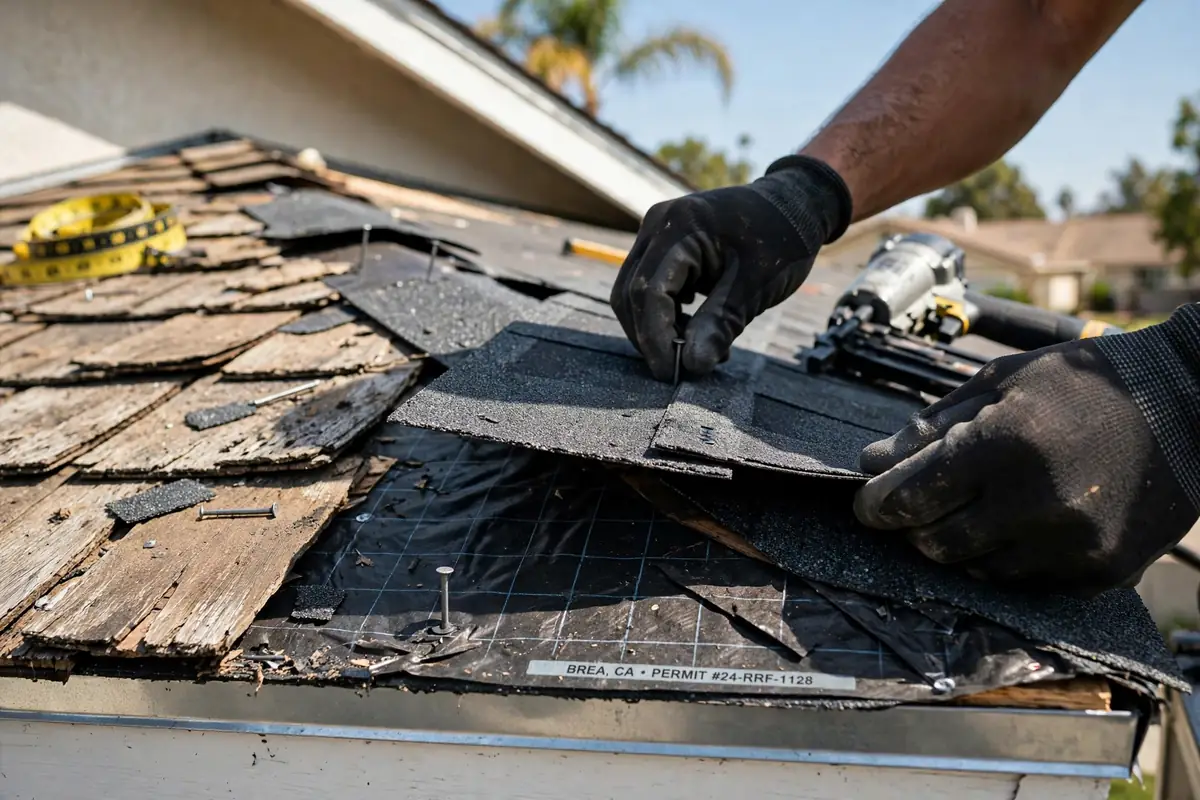
What This Service Includes
We tear off and replace only the failed sections, tying the new roofing into the existing roof with proper weaving, flashing transitions, and underlayment overlaps. The critical skill in partial work is the tie-in: done right, it is watertight and visually consistent; done poorly, it is a leak waiting to happen.
Signs You Need This Service
- Damage isolated to one slope or elevation
- A failed addition or dormer roof while the main roof is sound
- Valley or flashing failures on an otherwise healthy roof
- A roof under 15 years old with localized storm damage
- Budget constraints that make phasing the work sensible
How We Do It Right
We match existing shingle color and profile as closely as current manufacturing allows, and we are upfront about the one real tradeoff: new shingles next to weathered ones will show a visible difference until the older sections age. When the remaining roof is within a few years of replacement anyway, we will tell you that a full replacement is the better value — partial work should never be a sales tactic.
Partial Roof Replacement for Brea Homes
For Brea homes where damage is isolated — a wind-torn elevation here, a failed valley there — partial replacement delivers exactly what is needed without paying for what is not.
Related Roofing Services
Roof Ventilation Upgrade
Balanced intake and exhaust ventilation designed into every Brea replacement — protects shingles and warranties.
Asphalt Shingle Roof Replacement
Architectural shingle replacement for Brea homes: full tear-off, new underlayment, and premium shingles rated for heat and Santa Ana winds.
Tile Roof Replacement
Clay and concrete tile roof replacement in Brea, including underlayment renewal — the waterproofing layer that decides a tile roof's life.
Metal Roof Replacement
Standing-seam and exposed-fastener metal roof replacement in Brea — 40-70 year lifespan, fire resistance, and energy-saving reflectivity.
Areas We Serve
Brea Hills
Roof replacement in Brea Hills, Brea.
Tamarack
Roof replacement in Tamarack, Brea.
Olinda Ranch
Roof replacement in Olinda Ranch, Brea.
Downtown Brea
Roof replacement in Downtown Brea, Brea.
Helpful Guides
Roof Repair vs. Replacement: How Brea Homeowners Should Decide
Guide from Roof Replacement Specialists.
How Much Does Roof Replacement Cost in Brea?
Guide from Roof Replacement Specialists.
When partial makes sense
Three situations qualify. One: isolated storm or tree damage to one or two slopes while the rest tests healthy. Two: a failed addition or flat section tied to a sound main roof. Three: a roof where one exposure (usually south or west) aged out years ahead of the shaded slopes. What does not qualify: a uniformly 25-year-old roof where 'just the bad side' is a way to sell half a job — we will tell you when full replacement is the honest answer, even though it costs us the sale.
The tie-in is everything
A partial replacement lives or dies at the tie-in line. We cut back to a clean course, weave or step-flash the transition, run new underlayment up under the existing courses, and match manufacturer and color line as closely as current production allows. The warranty covers our work and the tie-in; it cannot cover the old roof it joins. You get that limitation in writing before we start — no fine-print surprises.
Partial pricing
Partial work is priced per slope or section, and per-square costs run higher than full replacement — mobilization, setup, and tie-in detailing do not scale down. A one-slope replacement on a simple ranch might run 40–60% of a full job. The honest comparison we give you: partial cost now plus the likely full replacement in 5–8 years, versus full replacement now. Sometimes partial wins; often the math favors doing it once.
Brea's partial candidates
The classic Brea partial: a 1970s–80s tract home in Birch Hills, Country Hills, or West Brea where the south-facing slope baked out years before the north slope. Another: wind damage confined to the windward slope after a Santa Ana event while the leeward slopes test fine. Tile roofs in the hillside communities almost never partial well — discontinued tile profiles make matching impossible — so we are blunt about that upfront.
The honest math: partial now vs. full later
We lay it out as two numbers: the partial scope now, and the likely full replacement in five to eight years when the remaining slopes age out. Sometimes partial clearly wins — a storm-damaged windward slope on an otherwise healthy 12-year-old roof. Sometimes full wins — a 22-year-old roof where the 'good' slopes are two summers from failing. Our job is to make both numbers real so your decision is arithmetic. We have talked homeowners out of partials that did not make sense, and we will again.
Frequently Asked Questions
Will a partial replacement match my existing roof?
We match manufacturer, color, and profile as closely as possible. There will be some visible difference between new and weathered shingles, which we discuss honestly before you decide.
Is a partial replacement cheaper in the long run?
It costs less today. But if the rest of the roof fails in three years, two mobilizations can exceed the cost of doing it all at once. We give you both numbers so you can decide with full information.
Will the new section match the old roof?
Closely, not perfectly. We match manufacturer and color line, but the old slopes have years of UV fading the new section does not. On the street view the difference usually reads as subtle; up close you can see the tie-in line. If blending matters to you, we will say so before you decide — some homeowners choose full replacement for appearance alone, and that is a valid reason.
Does a partial replacement come with a warranty?
Our workmanship warranty covers the new section and the tie-in detailing fully. The manufacturer material warranty covers the new materials. Neither can cover the existing roof or the seam's aging neighbor — that limitation is in your written scope, plainly stated.
How do you decide partial vs. full?
We test, not guess: shingle flexibility and granule retention on every slope, seal-strip adhesion, deck soundness, and remaining service life by exposure. You get a written slope-by-slope report with photos. If two or more slopes are marginal, we recommend full — a partial that needs its neighbor replaced in three years was the wrong call.
Can a partial replacement be financed?
Yes — the same plans available for full replacement apply to partial scopes. Because partial costs less, the terms are often shorter and simpler. We walk through the options during your estimate with the same plain-numbers approach as the scope itself.
Can a partial replacement be financed?
Yes — the same plans available for full replacement apply to partial scopes. Because partial costs less, the terms are often shorter and simpler. We walk through the options during your estimate with the same plain-numbers approach as the scope itself.