
Energy-Efficient Roofing Options for Brea Homes
Your roof is your home's largest heat-exchange surface. Choosing the right energy-efficient roofing system can cut peak cooling demand substantially in Brea's hot, dry summers and Santa Ana wind events.
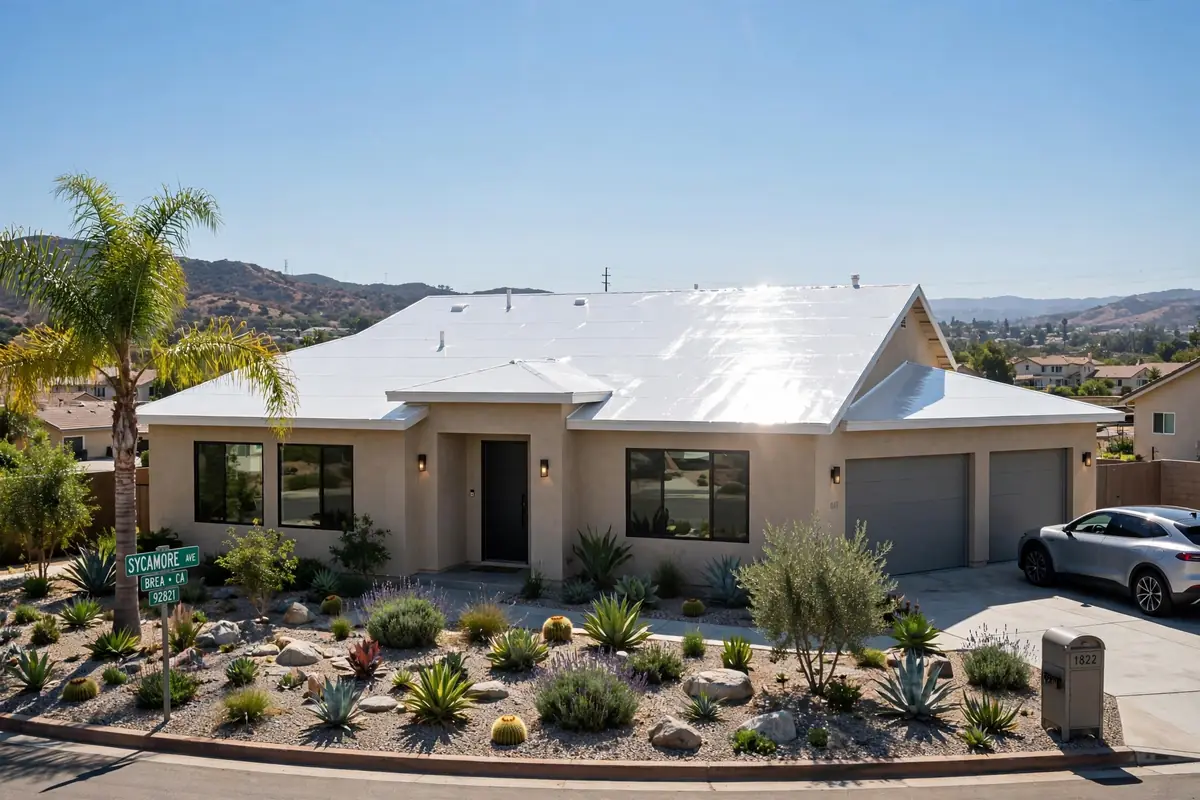
Cool-roof shingles
Infrared-reflective granules let these shingles wear traditional colors while reflecting far more solar heat than standard shingles. The most cost-effective efficiency upgrade for pitched roofs.
Reflective metal roofing
Standing-seam metal with reflective finishes is the efficiency champion for pitched roofs — reflecting heat, emitting what it absorbs, and lasting decades.
White TPO for flat sections
On low-slope roofs, white TPO membrane reflects the majority of solar energy. The cooling difference versus a dark built-up roof is dramatic.
Ventilation: the force multiplier
Reflective surfaces plus balanced attic ventilation compound each other's benefits. A cool roof over a trapped, superheated attic underperforms; the same roof over a ventilated attic transforms comfort.
Radiant barriers and insulation coordination
During replacement, adding a radiant barrier or upgrading attic insulation alongside the new roof captures savings that neither improvement achieves alone. We evaluate the whole thermal assembly, not just the surface.
Related Services
Areas We Serve
More Guides
How Much Does Roof Replacement Cost in Brea?
Guide from Roof Replacement Specialists.
7 Signs Your Brea Home Needs a Roof Replacement
Guide from Roof Replacement Specialists.
The attic is where efficiency is won or lost
The most efficient roof in the world underperforms over a suffocated attic. Before spending on premium materials, fix the physics: balanced intake and exhaust ventilation, sealed attic bypasses, and adequate insulation. We measure attic temperatures during inspection — the number usually shocks homeowners, and the ventilation correction that fixes it is the cheapest efficiency upgrade in roofing.
Ranking Brea's efficiency upgrades by payback
Fastest payback: ventilation correction (often under two cooling seasons). Next: cool-rated shingles or metal at reroof time (the incremental cost over standard is modest). Then: attic insulation and radiant barrier, cheapest when the deck is open during replacement. Slowest but largest lifetime impact: standing-seam metal plus solar, the 40-year play. We put the estimated annual savings next to each option's cost in writing.
The attic is half the system
A reflective roof over a suffocating attic is half a solution. Cool shingles or metal cut the heat coming in; balanced ventilation (soffit intake, ridge exhaust) moves the heat that still gets through. The pair works multiplicatively — we have measured attic drops far larger than either measure alone. Every cool-roof estimate we write includes the ventilation schedule, because selling one without the other is selling half a result.
What the utility bill tells you
Pull twelve months of electric bills before the estimate. The summer peak versus the spring baseline is roughly your cooling load — and the portion a cool roof plus ventilation can attack. We use your actual bills, not a generic model, to size the savings estimate. Homeowners are often surprised: the bill already contains the business case, waiting to be read.
One final note: start with the free inspection and the heat-load measurements. The numbers will tell you whether cool shingles, metal, or ventilation correction pays best for your specific home — and the written savings estimate turns a good decision into an obvious one.
Frequently Asked Questions
Will an energy-efficient roof really lower my bills?
Yes — particularly peak summer cooling. The exact savings depend on your insulation, ventilation, and AC system, and we will give you a realistic range rather than a fantasy number.
Are there tax credits or rebates?
CA utility and energy programs change regularly. We track current incentives and flag every one your project qualifies for during the estimate.
Will a cool roof make my house too cold in winter?
No — Brea winters are mild and the heating penalty of a reflective roof is tiny compared to the summer cooling gain. The Department of Energy's own modeling shows cool roofs as net winners in hot-summer climates like ours; the winter difference is a rounding error.
Do I need new insulation with a cool roof?
Not necessarily, but the combination multiplies. If your attic insulation is thin, compressed, or missing in spots — common in Brea's 1960s–80s homes — adding it during the reroof (when access is cheapest) alongside the cool surface delivers the full package. We assess and quote it as a separate line item.
Do cool roofs need special maintenance?
Slightly different, not harder: keep the surface clean, because dust and debris reduce reflectance. An annual rinse keeps performance near rated levels. Algae-resistant granules are standard in our cool shingle specs — Brea's occasional moisture plus shade can grow streaks on untreated roofs.
Will a cool roof help in winter too?
Modestly — winter heating in Brea is a small load, and a reflective roof reflects a little winter sun too. The net annual effect remains strongly positive because Brea's cooling season dominates. Proper attic insulation (which we assess during the inspection) keeps winter performance solid regardless of roof color.
Do I need new insulation with a cool roof?
Not necessarily, but the inspection assesses it — insulation and ventilation work as a system with the reflective surface. If your attic insulation is thin or displaced, addressing it alongside the cool roof multiplies the savings. The estimate shows the combined effect so you can decide with real numbers.